- The lab range and the decision threshold are not the same
- 1. Read the actual ferritin number
- 2. Ask whether inflammation is changing the picture
- 3. Find out why iron is low
- 4. Measure the response
- What to bring to your next visit
- Sources
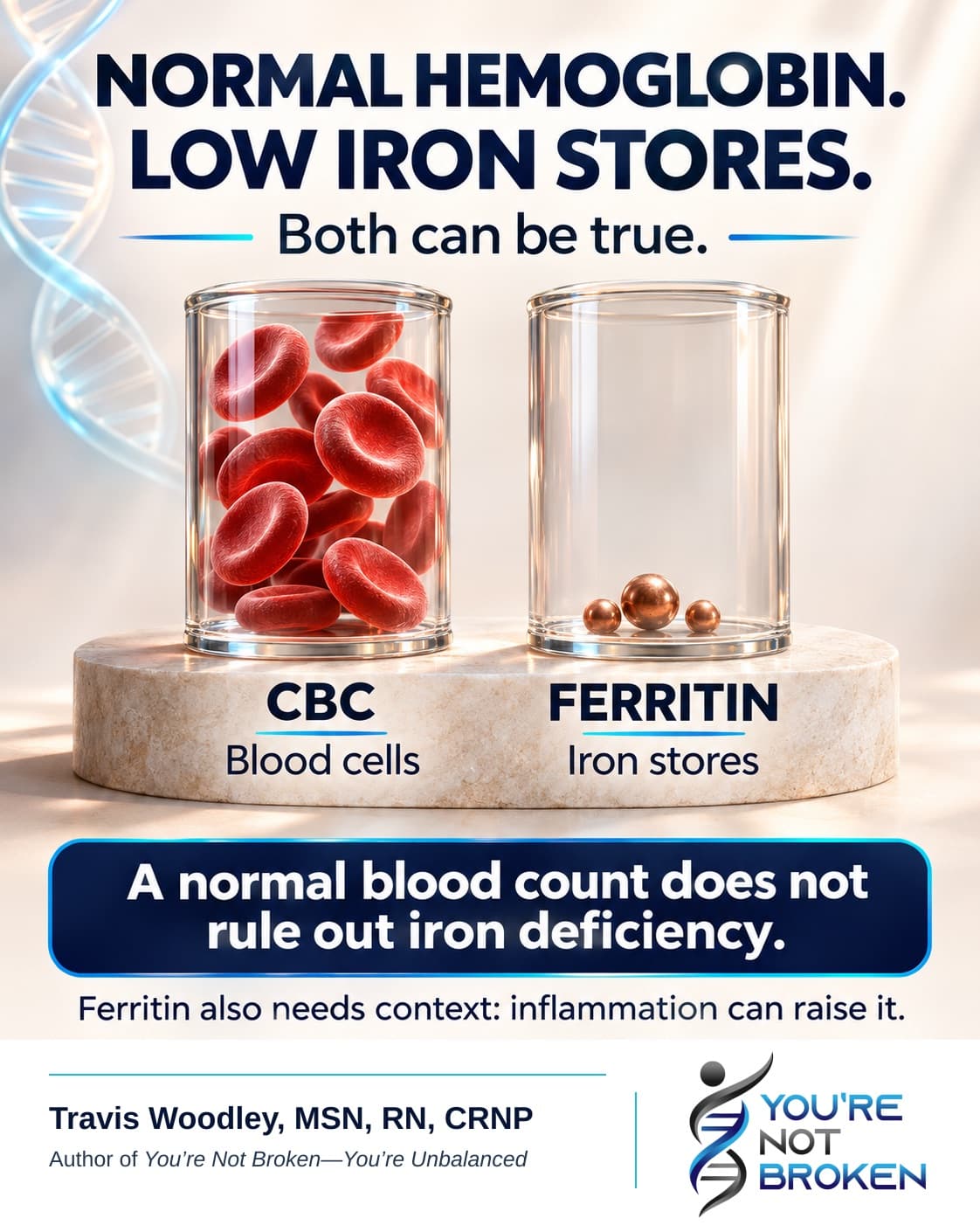
Your blood count can look normal while your iron stores are running low.
A ferritin of 24 ng/mL can be labeled "normal" and still meet a current guideline's criterion for iron deficiency. If only a CBC was checked, "you're not anemic" does not settle the iron question.
It is a familiar story: someone feels tired, foggy or short on stamina and is told their bloodwork was fine. Often it was fine for what was ordered. It just didn't answer the question that mattered.
The lab range and the decision threshold are not the same
A complete blood count, or CBC, looks at your blood cells, including hemoglobin. Ferritin is the routine marker of stored iron. Your body protects hemoglobin by drawing down its stores first, so the stores can run low while the CBC still looks normal. Both can be true at the same time.
The second problem is the number itself. The reference range printed on your lab report and the threshold a clinician uses to make a diagnosis can differ. A value can sit inside the lab's range and still meet a guideline's criterion for iron deficiency.
There are four things worth discussing at your next visit.
1. Read the actual ferritin number
Don't settle for "normal." Ask for the number.
In September 2026 the American Society of Hematology (ASH) published evidence-based guidelines for diagnosing iron deficiency. For nonpregnant adults without known or suspected inflammation, it suggests a ferritin cutoff of 30 ng/mL or below. The same 30 ng/mL threshold is suggested for people who menstruate. Symptoms or ongoing risk factors can make a threshold of 50 ng/mL or below appropriate.
These are conditional recommendations based on low-certainty evidence. They are not universal "optimal" targets, and they are not a reason to chase a higher number for its own sake. They are a reason to read your result carefully instead of stopping at the word "normal."
2. Ask whether inflammation is changing the picture
Ferritin can rise with inflammation. At the same time, inflammation can raise hepcidin, a hormone that reduces iron transfer from the gut and storage cells into the bloodstream.
So depleted stores and restricted iron availability are different problems. They can also coexist.
In adults with anemia of inflammation, ASH suggests checking ferritin plus transferrin saturation, which helps assess the iron that is actually available. Transferrin saturation is affected by what you recently ate, so the guideline advises drawing it after a fast that includes skipping iron supplements and multivitamins.
The guideline's discussion of ferritin below 100 ng/mL belongs to that inflammation context. It does not mean everyone needs a ferritin above 100.
If you have read our earlier piece on iron deficiency without anemia, this is the part where the new guideline adds numbers to what that article described.
"You're not anemic" does not settle the iron question.
Bring your actual CBC and ferritin results. The Start Here pathway helps you see which labs and which consultation fit before you book.
3. Find out why iron is low
The common causes are:
- Heavy periods
- Frequent blood donation
- Inadequate intake
- Poor absorption, including celiac disease
- Sometimes gastrointestinal blood loss
The next question is bigger than "Which iron supplement?" Replacing iron without addressing an ongoing loss leaves part of the problem unresolved. Heavy menstrual bleeding deserves its own evaluation, which we cover in heavy periods in perimenopause. Intake and absorption are where nutritional counseling can help.
Some findings call for prompt care rather than a routine visit: black or bloody stools, vomiting blood, chest pain, fainting, or shortness of breath at rest.
4. Measure the response
In a 12-week randomized trial of 198 nonanemic menstruating women with fatigue and ferritin below 50, iron improved fatigue more than placebo. Quality of life, depression and anxiety did not significantly improve.
That supports evaluating selected patients. It does not make iron a cure for every tired person. Fatigue has many causes, and low iron is only one of them; our guide to persistent fatigue beyond sleep walks through the others.
If treatment is started, agree on when to reassess symptoms and repeat the relevant labs. Rebuilding stores takes months, not days.
What to bring to your next visit
Before your next visit, gather:
- Your actual CBC and ferritin results, with the numbers
- Your bleeding and blood-donation history
- Your medications and supplements
Then ask: "Did we assess my iron stores, and what could explain a low result?"
Persistent fatigue deserves a full evaluation. Don't start high-dose iron because of a social media post; excess iron can be harmful.
A useful functional-medicine conversation connects symptoms, labs and causes, then checks whether the person actually improves. That is how we approach it at Revitalize, with comprehensive lab work read in the context of your history. You can book online at either our Columbus or Warner Robins clinic.
Travis Woodley, MSN, RN, CRNP. Author of "You're Not Broken — You're Unbalanced."
Sources
- American Society of Hematology 2026 guidelines for diagnosis of iron deficiency, Blood Advances, September 2026: doi.org/10.1182/bloodadvances.2025015950
- Vaucher P, et al. Effect of iron supplementation on fatigue in nonanemic menstruating women with low ferritin: a randomized controlled trial. CMAJ, 2012: pubmed.ncbi.nlm.nih.gov/22777991
Medical disclaimer: This article is for educational purposes only and is not medical advice, a diagnosis, or a treatment plan. Iron testing, interpretation, and treatment should be individualized and supervised by a qualified healthcare provider. Do not start high-dose iron or change supplementation on your own.
Travis spent 17+ years in high-acuity clinical medicine — emergency, cardiac ICU, and cath lab — before founding Revitalize. He is a Certified Platinum Biote hormone therapy provider, the published author of You're Not Broken — You're Unbalanced, and the founder of the Rebuild Metabolic Health Institute. His clinical writing reflects the same precision he brought to critical care: specific, honest, and built around what actually works.

Ready to talk it through with a clinician?
Book online or call either Georgia location. Every visit starts with a consultation.